Ken's Collection (Page under Construction)
|
Greek Coins (My Favorites)
|
|||
    Current Offerings              

|
(Double click for enlarged photo) |
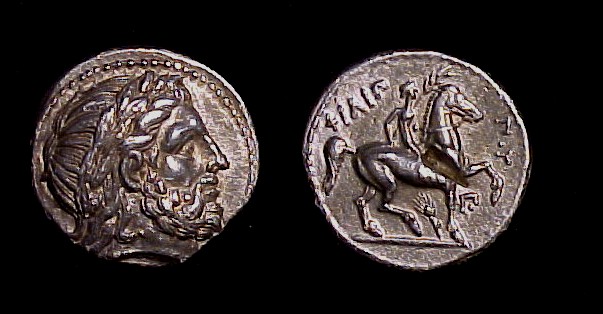
Silver Tetradrachm
– 350 BC, Macedonia Obv: Philip II as Zeus Historical Context: This coin was minted by the MACEDONIAN EMPIRE (494 - 168 BC) during the reign of Philip II, the father of ALEXANDER THE GREAT. The Macedonian empire was founded by Alexander I but carried forward by others including Philip II. Philip II developed the army and tactics that enabled Alexander the Great to accomplish his victories. When Philip II was young he won two Olympic equestrian victories. His coins often commemorate those victories. This coin shows Philip II's jockey on horseback running his "Victory Lap." It was tradition to run a victory lap holding a palm branch. The coin reverse shows Philip II holding the palm branch (See picture). The obverse (front) of this coin is ZEUS, CHIEF OLYMPIAN GOD. Many believe that this is the face of Philip II as ZEUS. I agree. This portrait looks much like the known portraits of his son, Alexander, thus, a family resemblance.
|
|
 (Double click for enlarged photo) |
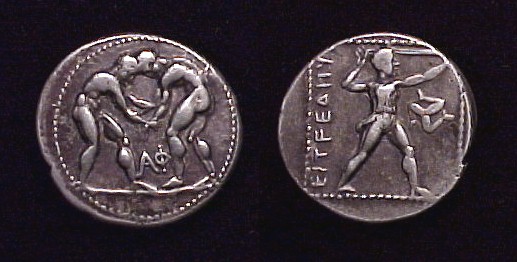
Silver Stater
- 370 BC, Aspendus Wrestlers of Aspendus - type Commemorates the Ancient Olympics Games !! Obv: Two Wrestlers grappling in a
Greco-Roman Historical Context: This coin was minted in ASPENDUS around 370-330 BC. The City of Aspendus is on the southern coast of Asia Minor (Pomphylia). These coins were struck to commemorate the ancient athletic games (Pan-Hellenistic Games). These Games were held in four cities, Olympia, Nemea, Corinth, and Delphi. The Olympic Games were part of this circuit when held in Olympia!! These coins are typically referred to as THE WRESTLERS OF ASPENDUS and are amongst the most collectable of all ancient coins!!!
|
||
(Double click for enlarged photo) |
|
||
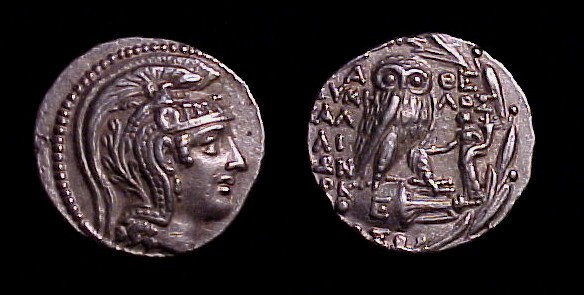
(Double click for enlarged photo) |
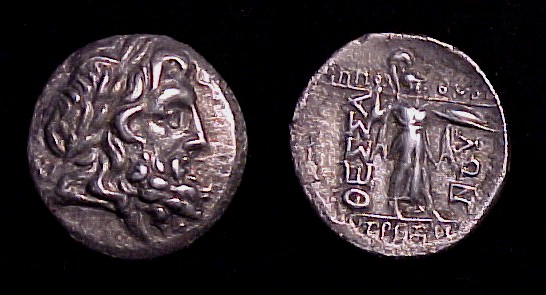
SILVER Double Victorius - 170 BC,
Thessalian League
Obv: Zeus Historical Context: This coin was minted by the THESSALIAN LEAGUE around 170 BC. The THESSALIAN LEAGUE exist from the 3rd – 1st Cent BC. The Thessalian league was a loose confederacy of feudal like states run by a few great Thessalian families. In times of need, they elected a chief magistrate called a Tagus. The seat of the Thessalian organization was Larissa. The Thessalian League included Thessaly and nearby islands. Thessaly is located in Central Greece. Note: Sharp Toning - Artificially applied
|
||
(Double click for enlarged photo) |
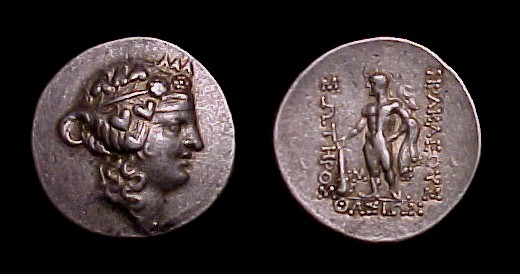
Silver Tetradrachm - 140 BC,
Thasos, Islands off Thrace Obv: Dionysos - God of Wine Rev: Herakles with Club and Lion Skin Historical Context: This coin was minted in THASOS about 148 - 100 BC. Thasos was a Thracian Island in Northern Greece. It was famous for its gold mines, but also as a center for cult worship of Dionysos, Greek God of Wine. The island was first under the control of the Phoenicians then it fell to the Persians and finally the Greeks. Following the death of Andriscus and the organization of Macedonia into a Roman province, the output went to the Thracian mints in Maroneia and Thasos for coin production. This coin is one of those coins.
|
||
(Double click for enlarged photo) |
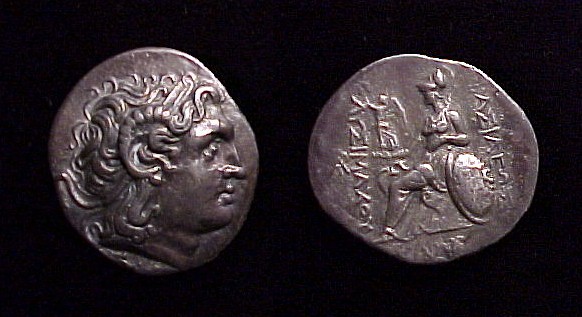
Silver Tetradrachm - 310 BC, Greek Empire under Lysimachus Obv: Alexander the Great wearing Horn
of Ammon Historical Context: This coin was minted by the MACEDONIAN EMPIRE some the after the death of Alexander the Great, around 320-300 BC. The Macedonian empire was founded by Alexander I but carried forward by others including Philip II (Father of Alexander the Great) and ALEXANDER the GREAT. Philip II developed the army and tactics that enabled Alexander the Great to accomplish his victories. Alexander the Great is considered the greatest military general ever. After his death, many of regions conquered by Alexander minted coins of this motif in his honor. The obverse (front) of this coin is Alexander the Great (His face) as Ammon, An EGYPTIAN DEITY. He is wearing “The Horn of Ammon.”
|
||
(Double click for enlarged photo) |
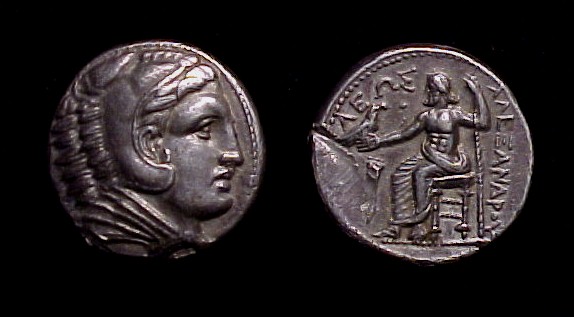
Silver Tetradrachm - 310 BC, Macedonian Empire - (Amphilopolis Mint) Obv: Alexander the Great as Herakles in Lion
Skin Historical Context: See above. The obverse (front) of this coin is Alexander the Great (His face) as Herakles (Same as Roman "Hercules"). He is wearing a Lion Skin. The Lion Skin is from the Nemeaen Lion killed by Herakles with his bare hands. The Lion Skin is said to protect him from his enemy’s spears and arrows.
|
||
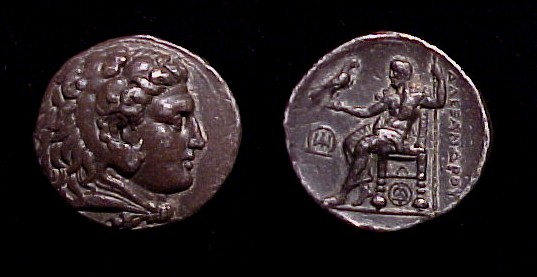
(Double click for enlarged photo) |
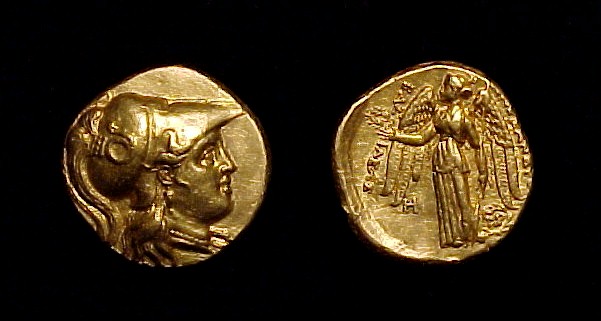
Silver Tetradrachm - 310 BC, Macedonian Empire - (Tyre Mint) Obv: Alexander the Great as Herakles in Lion
Skin Historical Context: See above.
|
||
(Double click for enlarged photo)
|
Gold Stater-330 BC Macedonian Empire - Minted under Alexander the Great Obv: Athena wearing her Helmet (slung back) Historical Context: See above. Note: This coin was used for the MuseumSurplus Company logo.
|
||
(Double click for enlarged photo) |
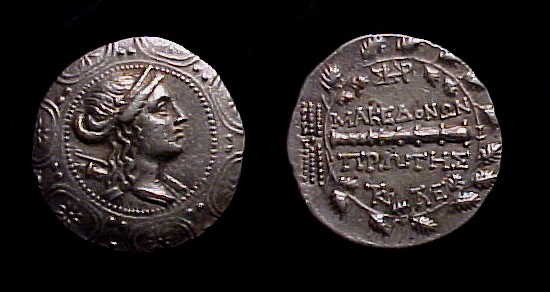
Silver Tetradrachm - 155 BC, Macedonia - Period of Roman Control Obv: Artemis-Goddess of the Hunt Rev: Club of Hercules in Wreath Historical Context: This coin was minted by the MACEDONIAN Empire in THESSALONIKA (Northern Greece) under ROMAN RULE between 158-149 BC. This city was called THERMA in an earlier period but received its more famous name in 315 BC in honor of Kassander’s (Greek ruler) wife Thessalonika the daughter of PHILIP II and sister to ALEXANDER the GREAT. This was during the period known as the ROMAN REPUBLIC. After the fall of the monarchy, it became the capital of the second republic established by the Romans. This is a period in which the Romans were just gaining their power.
|
||
(Double click for enlarged photo) |
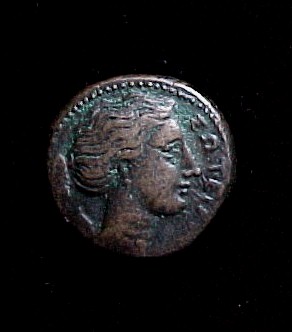
Greek AE22 - Agathokles - Circa 310 BC Syracuse, Sicily Obv: Artemis Historical Context: This coin was minted in SYRACUSE around 310 BC during the reign of Agathokles. Agathokles was a tyrant that travel from conquest to conquest throughout the Mediterranean.
|
||
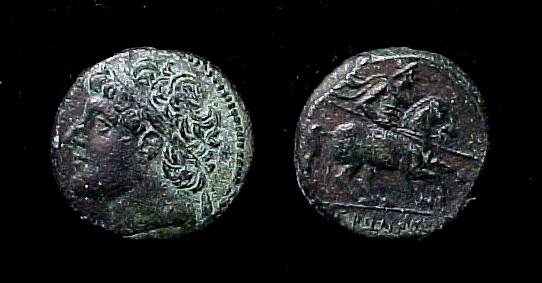
(Double click for enlarged photo) |
Greek AE27 - Hieron II - Late 3rd Cent BC Syracuse, Sicily Obv: Hieron II Historical Context: This coin was minted in SYRACUSE around 240 BC during the reign of HIERON II, 275-215 BC. This wise and popular ruler was the first Greek tyrant to openly place his image on coins of the realm. Rising from a humble beginning in Phthia, Hieron became the leader of the army and married the beautiful aristocrat Philistis. He was acknowledged as King of Syracuse by the will of the people.
|
||
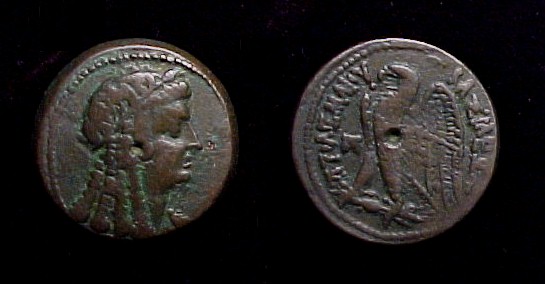
(Double click for enlarged photo) |
Egyptian AE 27, Ptolemaic Era, - 190 BC Obv: Cleopatra I as Isis Rev: Eagle, Wings Open Historical Context: This coin was minted by the Ptolemaic Empire in Egypt around 190 BC. The obverse (front) of this coin is CLEOPATRA the First as Isis (Cleopatra's face). Isis was an Egyptian deity, the wife of Orisis, the GOD of the DEAD. Cleopatra I was the daughther of Antiochos III of Syria became the wife of Ptolemy V of Egypt. She bore two boys and a girl ( Ptolemy VI, Ptolemy VII, and Cleopatra II). The Ptolemaic empire was founded by Ptolemy I after the death of Alexander the Great. Ptolemy I was a boyhood friend of Alexander and his most trusted general. After Ptolemy successfully completed the Persian war, Alexander granted him the area of Egypt. He founded an empire that lasted almost 300 years. The empire ended with Cleopatra VII, the Queen of the Nile.
|
||
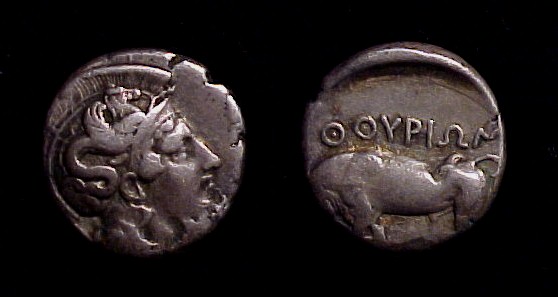
(Double click for enlarged photo) |
Silver Stater - 4th Cent BC Thourioi Region (Southern Italy) Obv: Athena, Helmet adorned with Hippocamp Historical Context: This coin was minted in Thourioi during the 4th century BC. Thourioi was an Athenian colony in 443 BC. It was located in southern most region of Lucania (Southern Italy). This area was located near the site of ruined Sybaris and was initially called New Sybaris and later changed to Thourioi. These types may be connected with the Italian campaign of the Epeirote King Alexander the Molossian, 334-330 BC, when he achieved a great victory over the Lucanians.
|
||
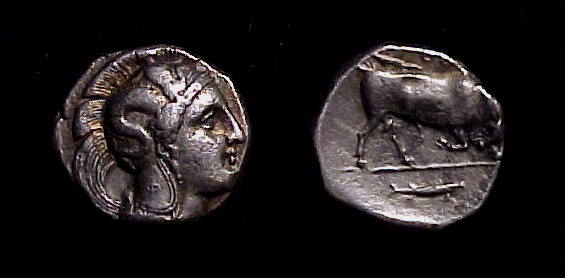
(Double click for enlarged photo) |
Silver Stater - 4th Cent BC Thourioi Region (Southern Italy) Obv: Athena, Helmet adorned with Historical Context: See above
|
||
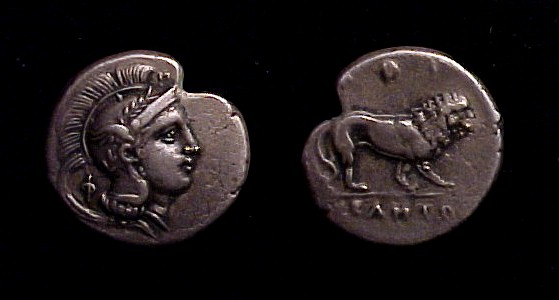
(Double click for enlarged photo) |
Silver Stater - 4th Cent BC Velia Region (Southern Italy) Obv: Athena, Corinthian Helmet Historical Context: This coin was minted in Velia during the 4th century BC. Velia is unlike many Greek cities in Italy. Velia was never captured by the Lucanians and in 275 BC became a Roman ally. Velia was located on Western coast of Lucania. This area during the 5th and 4th Centuries BC produced some of the finest ancient coins ever produced.
|
||
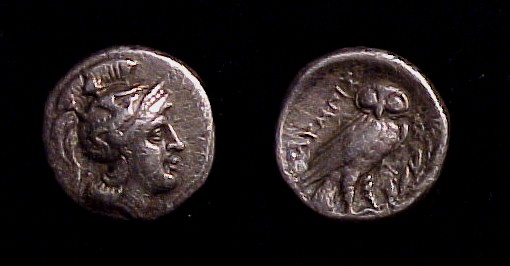
(Double click for enlarged photo) |
Silver Drachm - 3rd Cent BC Taretum (Calabria Region in Southern Italy) Obv: Athena, Helmet adorned with Historical Context: This coin was minted in CALABRIA, Taras (Taretum) during the 3rd century BC. Taretum was the most important Greek city in southern Italy during the 5th and 4th Centuries BC. Taras finally surrendered to the Romans in 272 BC.
|
||
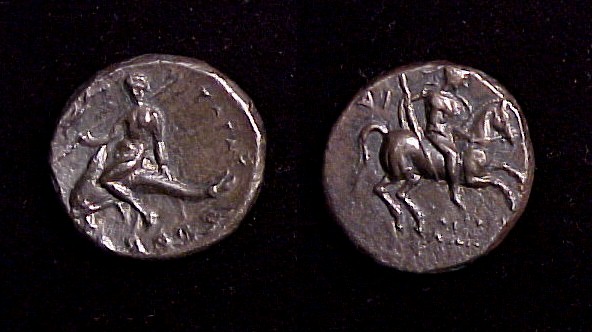
(Double click for enlarged photo)
|
Silver Stater - 4th Century BC Obv: Taras on Dolphin Historical Context: See above Historical Context
|
||
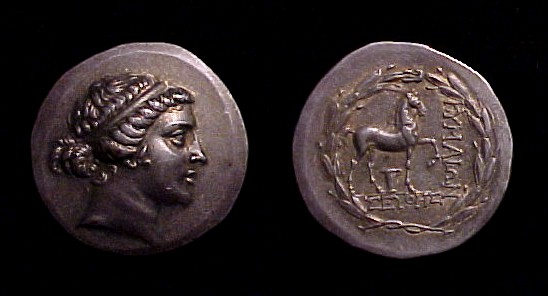
(Double click for enlarged photo)
|
Silver Tetradrachm - 2nd Cent BC Kyme Region Obv: Amazon Kyme Historical Context: This coin was minted in KYME about the second century BC. This coin is absolutely beautiful....One of my favorites
|
||
|
|
|||
|
My Collection of Early Roman Imperial Bronzes
|
|||
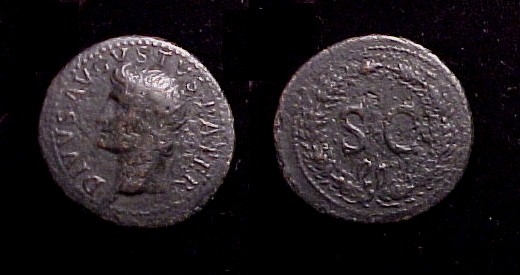
(Double click for enlarged photo) |
Bronze AS - Augustus (Octavian), 30 BC to 14 AD Obv: Augustus Historical Context: This coin was minted by the ROMAN EMPIRE during the reign of TIBERIUS honoring his adoptive father, AUGUSTUS (29 BC – 14 AD). Born as Gaius Julius Octavianus, he was the first Roman emperor. Great nephew of Julius Caesar who adopted him as heir to the throne. He joined Mark Antony and Lepidus in forming the Second Triumvirate to defeat Brutus. Later he opposed Marc Antony (with Cleopatra) and defeated them at the Battle of Actium. For this he received the title of Augustus (emperor) from the Senate and became the ruler of the Roman world in 29 B.C. He set in place much of the Roman Government that allowed them to prosper as an empire for 500 years. Died in AD 14 at the age of 77.
|
||
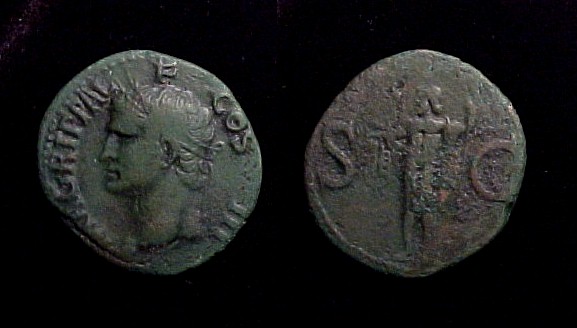
(Double click for enlarged photo) |
Roman Bronze
AS - 30 to 11 BC, Agrippa Heir to Octavian's Throne / Neptune Reverse Obv: Agrippa Historical Context: This coin was minted by the ROMAN EMPIRE during the early period of the reign of AUGUSTUS (29 BC – 14 AD) honoring his heir apparent and most loyal General. AGRIPPA was born 63 BC, he was a class-mate and boyhood friend of Augustus. He sided with Augustus during the civil war and served with great distinction. He led Augustus’ fleet to victory over Mark Anthony at Actium in 31 BC. He later married Augustus’ daughter, Julia, in 18 BC. Agrippa died unexpectedly in 11 BC.
|
||
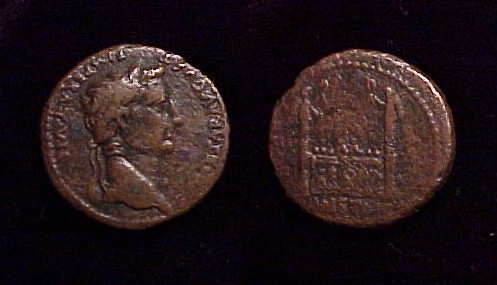
(Double click for enlarged photo) |
Roman Bronze
AS - 14 to 37 AD Reign of Tiberius, Rome's Second Emperor Emperor during the adult life of Jesus Christ
Obv: Tiberius Historical Context: This coin was minted by the ROMAN EMPIRE during the reign of TIBERIUS (14 – 37 AD). He was born into a highly distinguish clan (the Claudii), he was only four years old when his Mother divorved her husband and married Octavian (later Augustus). He served Augustus as a military commander, participating in the Battle of Actium, where Marc Antony and Cleopatra’s forces were defeated. He succeeded Augustus in 14 AD and he was succeeded by Caligula when he died of natural causes.
|
||
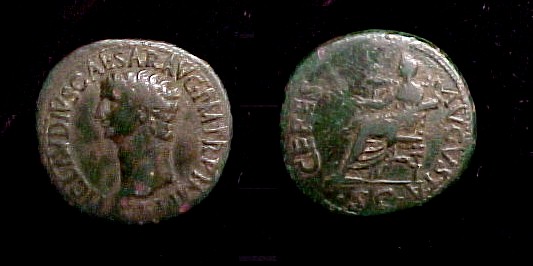
(Double click for enlarged photo) |
Roman Bronze
AS - 41 to 54 AD Reign of Claudius
Obv: Claudius Historical Context: This coin was minted by the ROMAN EMPIRE during the reign of CLAUDIUS (41 - 54 AD). Tiberius Claudius Drusus suffered a childhood attack of infantile paralysis had left him with a grotesque appearance. When he was proclaimed emperor he proved himself a very capable administrator. He married his niece, Agrippina Junior, and adopted her son, Nero. He died in 54 under suspicious circumstances, most likely died by poisoning by Agrippina Jr. to assure the assession of her son, Nero, to the throne.
|
||
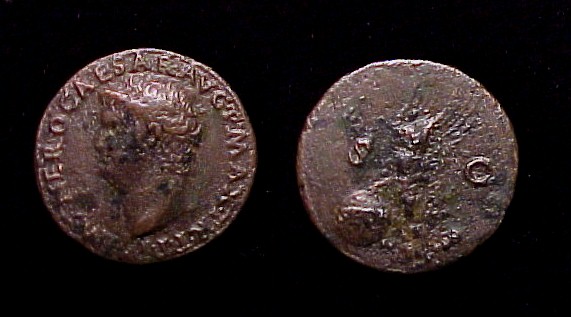
(Double click for enlarged photo) |
Roman Bronze
AS - 54 to 68 AD Reign of Nero
Obv: Nero Historical Context: This coin was minted by the ROMAN EMPIRE during the reign of NERO (54-68 AD). He was the son of Agrippina Junior, Clausius’ niece and later adopted by Claudius. Nero rose the throne when Claudius died in 54, poisoned by orders of Agrippina. (Nero’s mother). He is usually credited with starting the great fire of Rome in 64 AD. He subsequently blamed the Christians for the fire, subjecting 1,000’s of them to public execution. His power was broken by a revolt in Gaul and he committed suicide.
|
||
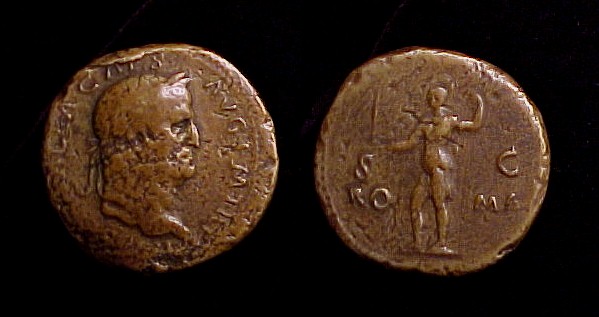
(Double click for enlarged photo) |
Bronze Sestertius - Galba, 68-69 AD Obv: Galba Historical Context: This coin was minted by the ROMAN EMPIRE during the reign of GALBA (68-69 AD). Born Servius Sulpicius Galba, he became a distinguished Senator, who served the Julio-Claudian line of Emperors since the days of Augustus. He was a particular favorite of Livia, from whom he inherited a fortune of some 32 million sestertii. Wow!!! Under Nero, he served as Governor of Nearer Spain. He was declared Imperator (Dictator) on April 2, 68 AD, at age 71. He was not a particularly effective emperor, apparently making numerous blunders, alienating the Army and Praetorian Guard. Galba was later murdered by forces of Otho, who succeeded him.
|
||
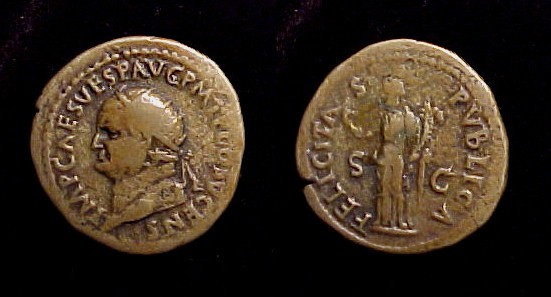
(Double click for enlarged photo) |
Bronze Dupondius - Vespasian, 69 to 79 AD Obv: Vespasian Historical Context: This coin was minted by the ROMAN EMPIRE during the reign of VESPASIAN (69 – 79 AD). T. Flavius Vespasianus, the son of Flavius Sabinus, a tax-gatherer, and Vespasia Polla. Despite his humble origin, his military skill carried him to a series of important posts, including the invasion of Britain and the revolt in Judea. In 69, he was proclaimed emperor. He quickly set about repairing the damage caused by the civil wars. He proved to be a just and industrious ruler. He died and was deified by the Senate.
|
||
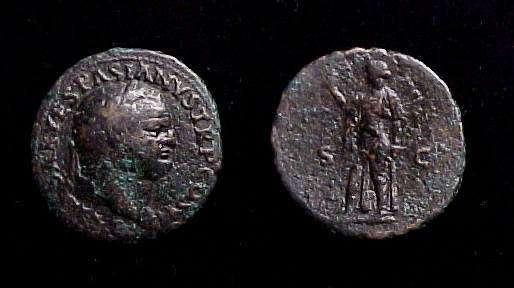
(Double click for enlarged photo) |
Bronze AS - Titus, 79 to 81 AD Obv: Titus Historical Context: This coin was minted by the ROMAN EMPIRE during the reign of TITUS (79 – 81 AD). Titus Flavius Vespasianus, born in 41, was the elder son of Vespasian and Flavia Domitilla. He later served in Germany and Britain and commanded a legion in his father's Jewish campaign. When Vespasian left, Titus remained to carry on the war and captured Jerusalem in 70. He proved himself an excellent leader and he was deeply mourned when he died prematurely in 81 AD.
|
||
(Double click for enlarged photo) |
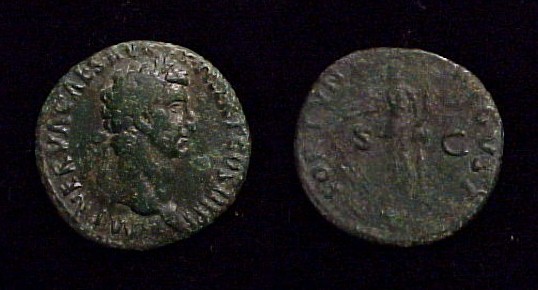
Bronze AS - Nerva, 96 to 98 AD Obv: Nerva Historical Context: This coin was minted by the ROMAN EMPIRE during the reign of NERVA (96 - 98 AD). Nerva was a distinguish senator. He served important roles under Nero, Vespasian and Domitian. At the death of Domitian he was raised to throne but died of natural causes after a reign of only 1 1/2 years. Nerva made one of the most fortunate decisions of all time by deciding to select his successor based on merit. He adopted Trajan to succeed him. They are known as the adoptive emperors. This was the beginning of the Golden Era of Rome.
|
||
(Double click for enlarged photo) |
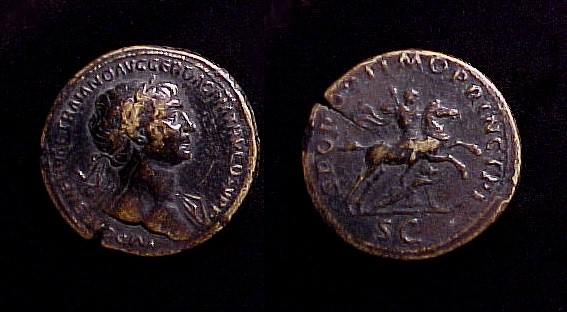
Bronze Sestertius - Trajan, 117-138 AD Obv: Trajan Historical Context: This coin was minted by the ROMAN EMPIRE during the reign of TRAJAN ( 98-117 AD). Marcus Ulpius Trajanus held several military posts and was eventually appointed governor of Upper Germany by Nerva who adopted him. On his succession, Trajan decided that the time was ripe for territorial expansion and he successfully undertook the conquest of Dacia which then became a Roman province. Trajan became emperor through his adoption by Nerva. He later adopted Hadrian as his successor.
|
||
(Double click for enlarged photo) |
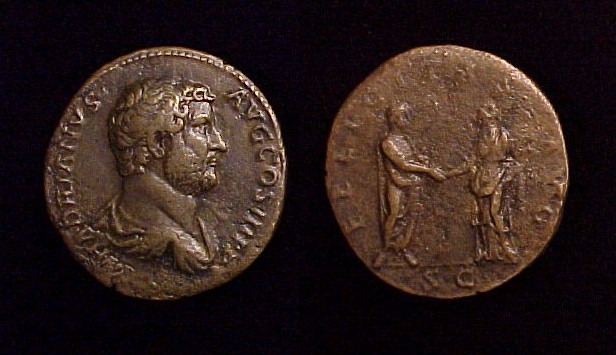
Bronze Sestertius - Hadrian, 117-138 AD Obv: Hadrian Historical Context: This coin was minted by the ROMAN EMPIRE during the reign of HADRIAN A.D. 117 - 138. P. Aelius Hadrianus, having lost his father he was placed under the care of a guardian, Trajan, a future emperor. In 100 he married Trajan's grand-niece, Sabina. He is best known as the builder of the great wall from the Tyne to the Solway in the United Kingdom. His rule was firm and humane and he was also a patron of the arts. He later adopted Antoninus Pius as his heir, whom succeeded him. They are known as the adoptive emperors. This was the Golden Era of Rome.
|
||
(Double click for enlarged photo) |
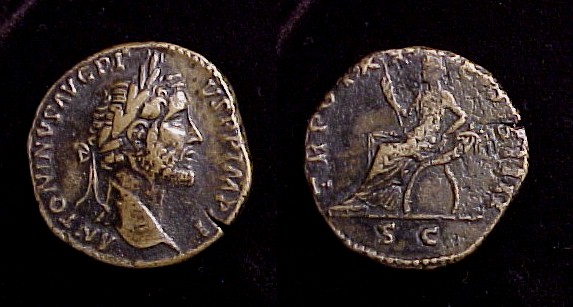
Bronze Sestertius - Antonius Pius, 138 to 161 AD Obv: Antonius Pius Historical Context: This coin was minted by the ROMAN EMPIRE during the reign of ANTONINUS PIUS (138 - 161 AD). Titus Aurelius Fulvus Boionius Arrius Antoninus was a senator. He was adopted by Hadrian as his heir in 138 and his succession was smooth. The history of his reign is minimal owing to the tranquillity and prosperity which Roman world enjoyed under the patient, judicious and impartial rule. He also adopted Marcus Aurelius as his successor. They are known as the adoptive emperors.
|
||
(Double click for enlarged photo) |
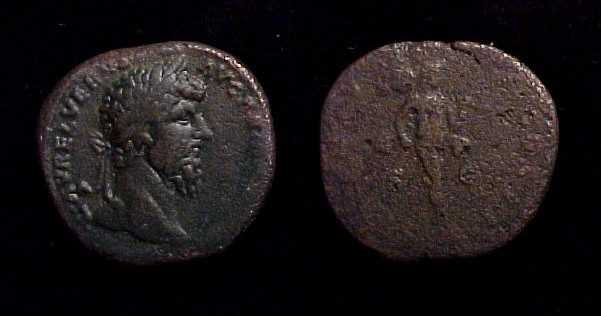
Bronze Sestertius - Lucius Veras, 117-138 AD Obv: Lucius Veras Historical Context: This coin was minted by the ROMAN EMPIRE during the reign of LUCIUS VERUS (161 to 169 AD). Lucius Ceionius Commodus, born 130 AD. He was the son of Aelius Ceaser, who was Hadrian’s intended heir. His fathger died when he was 8 years old. Hadrian compelled Antonius Puis to adopt Lucius. He reigned jointly with Marcus Aurelius. Their rule was plagued by disease and Parthain invasions. However, Lucius died prematurely in 169 AD at the age of 39.
|
||
(Double click for enlarged photo) |
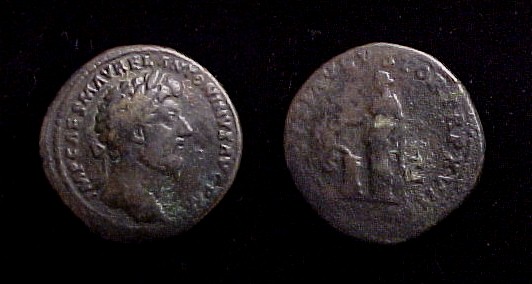
Bronze Sestertius - Marcus Aurelius, 161 to
180 AD Obv: Marcus Aurelius Historical Context: This coin was minted by the ROMAN EMPIRE during the reign of MARCUS AURELIUS (139 - 180 AD). He was later adopted by Antoninus and took the name of M. Aelius Aurelius Verus. In 139 he was Caesar and in 145 he married Faustina Jr, the daughter of Antoninus. He became Augustus in 161. The reign was disturbed by many frontier wars, resulting in a plague which spread throughout the empire.
|
||
(Double click for enlarged photo) |
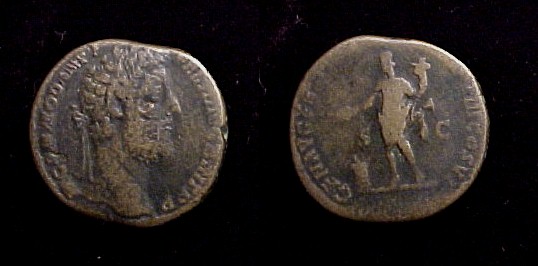
Bronze Sestertius - Commodus, 177 to 192 AD Obv: Commodus Historical Context: This coin was minted by the ROMAN EMPIRE during the reign of COMMODUS (177 - 192 AD). L. Aelius Aurelius Commodus was the son of Marcus Aurelius and Faustina Junior. He was made Augustus and co-emperor in 177. He proved a most unworthy son of a noble father. During his last years he seems to have become quite insane: he was fighting wild beasts in the amphitheater, and he believed himself the reincarnation of Hercules. He was eventually murdered, strangled in his bath by the Praetorian Guard.
|
||
|
|
|||
|
My Collection of SUN GODS
APOLLO -
|
|||
(Double click for enlarged photo) |
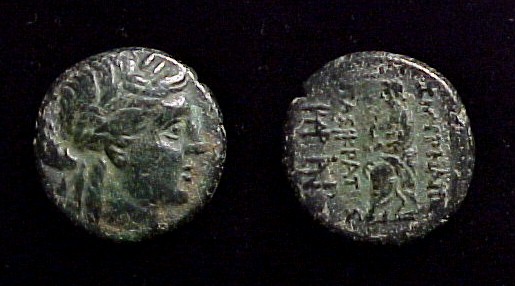
Greek AE22 - Ionia, Smyma, 115 - 100 BC
Obv: Apollo with Laurel Wreath Historical Context: This coin was minted in Smyma about 115 to 100 BC. Smyma was located in western "Asia Minor" was originally settled by the Aiolians (Ionians) but was taken and destroyed by Alyattes of Lydia. It later became one of the most important cultural centers in "Asia Minor." HOMER, The Poet, featured on the reverse is considered one of the greatest personalities of antiquity. Smyma claimed to be the birthplace of Homer.
|
||
(Double click for enlarged photo) |
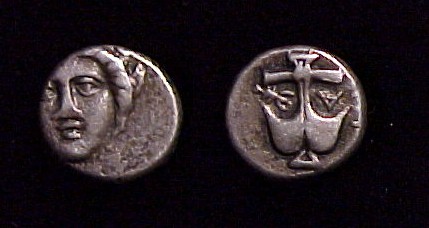
Greek AR Diobol - Apollonia Pontica, Thrace, 4th Cent
BC
Obv: Apollo, Facing (Off center) Historical Context: This coin was minted in Apollonia Pontica (Thrace) during the 4th century BC. THRACE: was a coastal area of Northern Greece (coastline along the Black Sea). There was a large amount of silver coinage issued in the first half of the 4th Century BC suggesting it was a place of commercial importance. Apollonia Pontika was a colony of Miletos and boasted a fine temple of APOLLO (Hence the name) with a statue by the sculptor Kalamis.
|
||
(Double click for enlarged photo) |
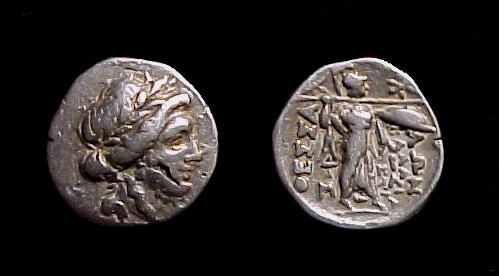
Greek AR Drachm - Thessalian League, 3rd to 1st Cent
BC
Obv: Apollo with Laurel Wreath Historical Context: This coin was minted by the Thessalian League about 3rd to the 1st century BC. The Thessalian league was a loose confederacy of feudal like states run by a few great Thessalian families. In times of need, they elected a chief magistrate called a Tagus. The seat of the Thessalian organization was Larissa. The Thessalian League included Thessaly and nearby islands, located in Central Greece.
|
||
(Double click for enlarged photo) |
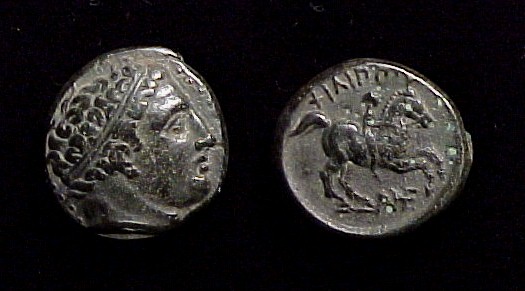
Greek AE16 - 350 BC, Macedonia Reign of Philip II Commemorates his OLYMPIC GAMES VICTORY !! Obv:
Apollo Historical Context: This coin was minted by the MACEDONIAN EMPIRE (494 - 168 BC) during the reign of Philip II, the father of ALEXANDER THE GREAT. The Macedonian empire was founded by Alexander I but carried forward by others including Philip II. Philip II developed the army and tactics that enabled Alexander the Great to accomplish his victories. When Philip II was young he won two Olympic equestrian victories. His coins often commemorate those victories. This reverse of this coin shows Philip II on horseback. Some believe the reverse is intended to be Alexander the Great (as a boy) on Horseback, referring to a challenge that Philip issued to Alexander regarding riding a certain horse. (See picture). The obverse (front) of this coin is Apollo. Some
of Philip's gold staters have Apollo with the features of
Alexander. This bronze unit has similar features.
|
||
(Double click for enlarged photo) |
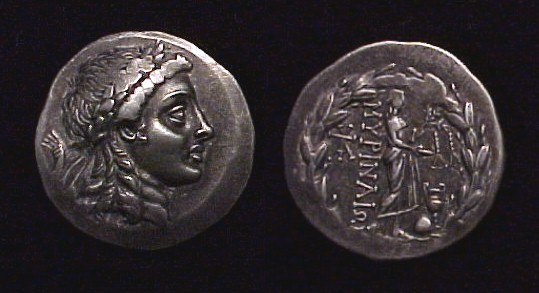
SILVER Tetradrachm
– 2nd Century BC, Myrina
Obv: Young APOLLO Historical Context: This coin was minted in MYRINA during the 2nd Century BC. Myrina was located north-east of Kyme (western shore of Aiolis) and was overshadowed by its more important neighbor. Myrina was believed to be of some importance during Hellenistic times. This coin for sale on my "Greek Coins" page.
|
||
|
|
HELIOS - Greek God of the Sun | ||
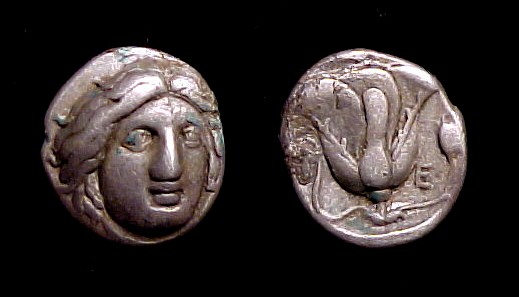
(Double click for enlarged photo) |
Greek AR Didrachm - 387 - 304 BC,
Rhodos Obv: Helios, Facing Rev: Youth on Horseback Historical Context: This coin was minted RHODOS about 387 to 304 BC. Rhodos was a large and important island off the southwest coast of Asia minor. It quickly achieved great prosperity and eventually became one of the principal trading centers in the area. HELIOS was the sun-god who crosses the sky from east to west each
day. He sees and hears everything. He was identified with Apollo.
|
||
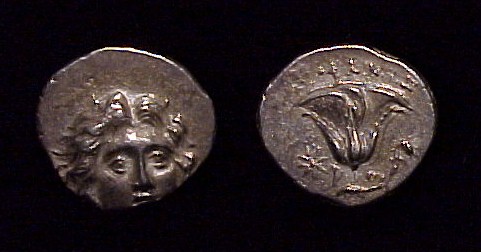
(Double click for enlarged photo) |
Greek AR Hemidrachm - 3rd Century BC,
Rhodos Obv: Helios, Facing Rev: Youth on Horseback Historical
Context: This coin was minted in RHODOS about 3rd Century
BC. Rhodos was a large and important island off the southwest
coast of Asia minor. It quickly achieved great prosperity and eventually
became one of the principal trading centers in the area.
|
||
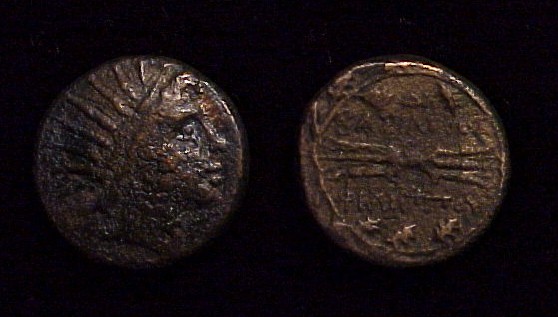
(Double click for enlarged photo) |
Greek AE23 - 200 BC, Macedonia Reign of Philip V Obv:
Helios Historical Context: This coin was minted by the MACEDONIAN EMPIRE (494 - 168 BC) during the reign of Philip V.
|
||
|
|
|||
|
SOL - Roman God of the Sun
|
|||
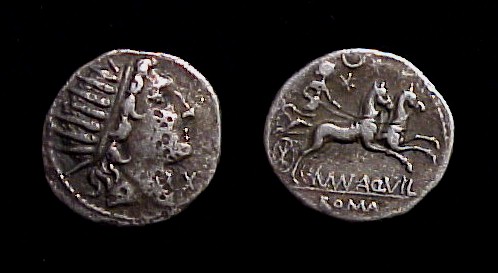
(Double click for enlarged photo) |
Roman Republic Denarius - 109 BC, Moneyer: Mn. Aquillius Obv: Sol Rev: Luna in Biga (Two horse chariot) Historical
Context: This coin was minted by the ROMAN REPUBLIC (before
the EMPIRE) during the 2nd-1st Century BC. During the late period of the
Roman Republic the issuance of coinage was administered by annually
elected magistrates ("Moneyers"). The moneyers were swept up
into the revolutionary tide created by the warlords as the Republic grew
in strength. Internal conflicts raged between Roman generals. This is
the era of Julius Caesar, Marc Anthony, Brutus, and Pompey. Following an
intense civil war, Julius Caesar prevailed over the forces of Pompey and
became dictator. Of course Brutus later murdered Caesar and began a war
with Marc Anthony, Octavian, and Pompey. Octavian prevailed and
the Roman Empire was founded.
|
||
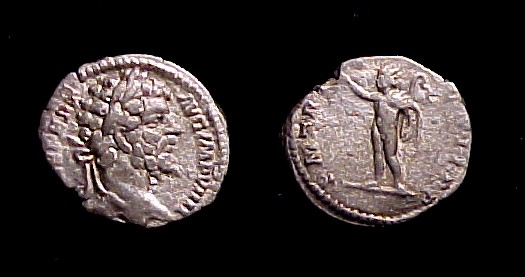
(Double click for enlarged photo) |
Roman Denarius - 193 to 211 AD Reign of Septimus Severus Obv: Septimus Severus Rev: Sol holding Whip, Raising Hand Historical
Context: This coin was minted by the ROMAN EMPIRE during the
reign of SEPTIMUS SEVERUS (193 - 211 AD). Septimus Severus was an
outstanding soldier. At the death of Commodus (the young emperor in the
recent movie "Gladiator"), he expressed his allegiance to
Pertinax, but after his murder and the elevation of Didius Julianus,
Severus was saluted as emperor by his troops. He went on to defeat the
forces of Julianus and became emperor. He founded a dynasty in Rome that
lasted a number of generations. Some of the oddest people ever to rule
Rome were part of this dynasty and brought onto the empire one of its
most turbulant periods.
|
||
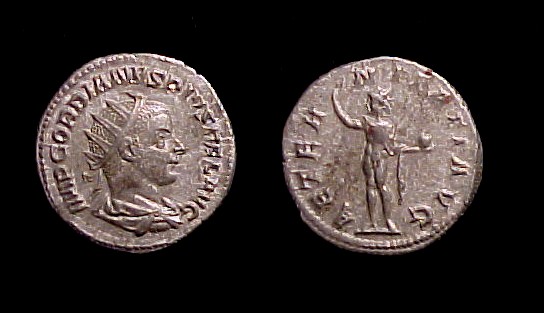
(Double click for enlarged photo) |
Roman Antoninianus - 242 to 246 AD Reign of Gordian III - The "Boy Emperor" Obv: Gordian III Rev: Sol holding Globe, Raising Hand Historical Context: This coin was minted by the ROMAN EMPIRE during the reign of GORDIAN III (238-244 AD). Gordian III was the grandson of Gordian I. He became known as "The Boy Emperor." In a political move, he was given the title of Caesar by the joint emperors Balbinus and Pupienus at age 13 years. Upon their deaths he was raised to the rank of emperor (Augustus). Little is known about his reign. There was a rebellion in Africa, promptly suppressed, in 240 AD. He is believed to be generally successful. Gordian was deposed and murdered near Circesium in Mesopotamia apparently a plot by his successor, Philip I ("The Arab").
|
||
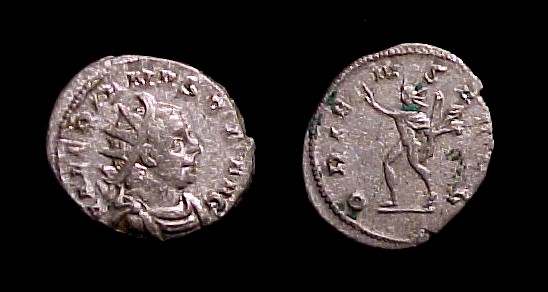
(Double click for enlarged photo) |
Roman Antoninianus - 253 to 260 AD Reign of Valerian - Future Footstool Obv: Valerian Rev: Sol holding Scepter, Running left Historical
Context: This coin was minted by the ROMAN EMPIRE during the
reign of VALERIAN I (253-260 AD): Valerian descended from a Senatorial
family, became legate of troops on the Rhine when, upon the death of
Treb. Gallus, his armies raised him as Augustus (Emperor). He was a competent
ruler and sought remedies for the chaos that had besieged the empire. He
divided the empire into two separate administrative halves to provide
better control. Valerian was later captured by an enemy, Persian ruler
Shapur. Shapur finally had Valerian killed, skinned, and his skin tanned
to leather and turned into a footstool. The footstool was used to mount
his horse.
|
||
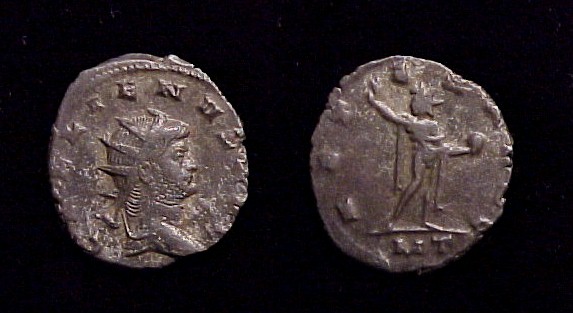
(Double click for enlarged photo) |
Roman AE Antoninianus - 253 to 268 AD Reign of Gallienus Obv: Gallienus Rev: Sol holding Globe, Raising Hand Historical Context: This coin was minted by the ROMAN EMPIRE during the reign of GALLIENUS (253 - 268 AD). Gallienus, son of Valerian, was made co-emperor soon after his father’s elevation. After the capture of Valerian by the Persians, Gallienus became a ruler of the whole empire subject not only to fierce barbarian attacks, but rent by internal revolts, famine and plagues. Gallienus was murdered at the siege of Milan along side his wife, Emperess Salonina.
|
||
(Double click for enlarged photo) |
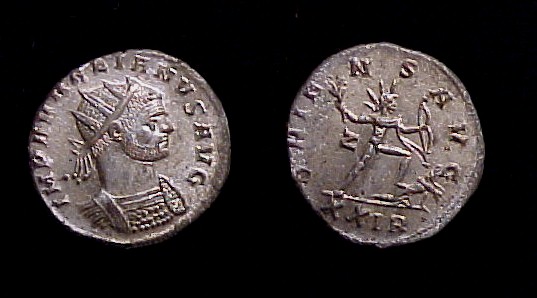
Roman "Silvered" Antoninianus - 270 to 275 AD Reign of Aurelian - Military Emperor Obv: Aurelian Rev: Sol holding Bow, Running right Historical Context: This coin was minted by the ROMAN EMPIRE during the reign of AURELIAN (270 - 275 AD). Aurelian, by his skill became one of the Empire's greatest generals. After the death of Claudius Gothicus, he was proclaimed emperor and after the suicide of Quintillus, he was left as undisputed. He completely restored the Roman Empire to its former extent. He then initiated the construction of a wall around Rome. However, in spite of his success, Aurelian was assassinated by his officers.
|
||
(Double click for enlarged photo) |
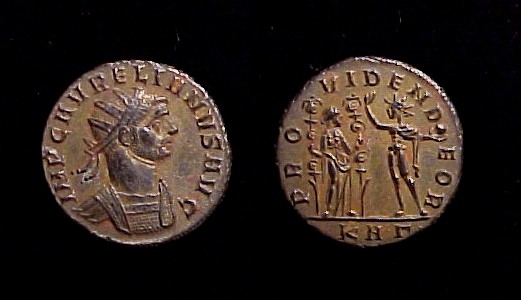
Roman AE Antoninianus - 270 to 275 AD Reign of Aurelian - Military Emperor Obv: Aurelian Rev: Sol facing Concordia, holding Military Standards Historical Context: See above "Historical Context."
|
||
(Double click for enlarged photo) |
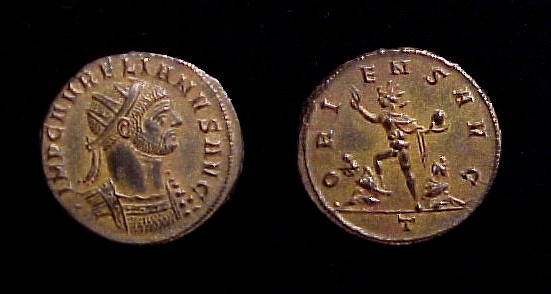
Roman AE Antoninianus - 270 to 275 AD Reign of Aurelian - Military Emperor Obv: Aurelian Rev: Sol holding Globe, Trampling Enemies at his Feet Historical Context: See above "Historical Context."
|
||
(Double click for enlarged photo) |
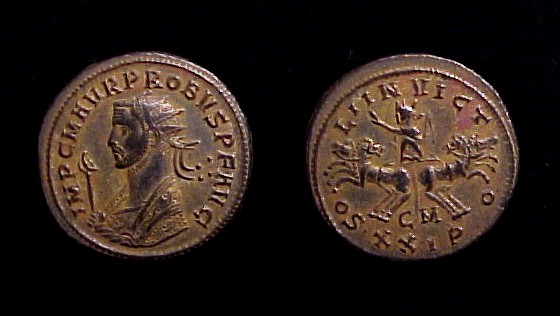
Roman AE Antoninianus - 276 to 282 AD Reign of Probus Obv: Probus Rev: Sol driving Quadriga (Face on) Historical Context: This coin was minted by the ROMAN EMPIRE during the reign of PROBUS (276 - 282 AD). Probus gained rapid promotion in the army, by the reign of Aurelian, he had become one of the leading generals. Soon after the death of Tacitus he was proclaimed emperor. He initiated a series of civics work using the soldiers. The soldiers resented this perceiving it as a degradation of power and in the autumn of 282 he was murdered by a band of mutinous soldiers.
|
||
(Double click for enlarged photo) |
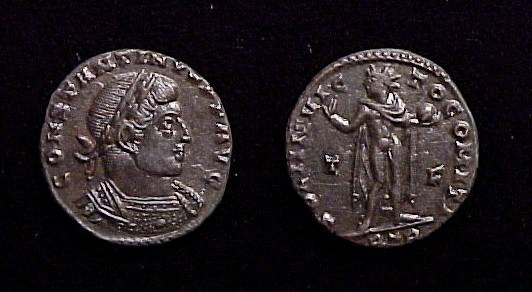
Roman AE3 Bronze - 308 to 337 AD Reign of Constantine the Great Obv: Constantine the Great Rev: Sol holding Globe Historical Context: This coin was minted by the ROMAN EMPIRE during the reign of CONSTANTINE the Great (308-337). By the Edict of Milan he recognized Christianity, the first Roman emperor to do so. He attributed a great victory to a Christian symbol seen during battle, which facilitated his conversion to Christianity. Among Constantine’s accomplishments he selected the first Pope to be placed in the VATICAN !! In addition, he and his mother, Helena, became SAINTS (St. Constantine and St. Helen). They are amongst the earliest of CHRISTIAN SAINTS!!
|
||
| This page is under construction. I have many more coins to post. |
Content Copyright 2000, MuseumSurplus.com (Ken Martins)
Source code and object code
Copyright 1998, Primecom Interactive, Inc.
Subject to terms of license agreement.